300 points, whatever you do: how Deadlock really counts ranked points
Two million ranked matches examined: neither your kills nor your rank change what you earn. Only two mechanisms move the number — and both work in your favour.
How much is a ranked win worth in Deadlock? The question comes up every game, and the answers go in circles: it supposedly depends on who was favoured, on your performance, on the enemy's rank. We opened the counters on 2,178,149 ranked matches, played by 174,132 players between August 3 and 17.
The answer is simpler than the rumour, and more interesting.
A flat fee, not a calculation
A win pays 300 points. A loss costs 300. In 69% of wins and 79% of losses, that is the exact figure, down to the unit.
There is no hidden formula behind it. There is a flat fee, and two mechanisms that adjust it at the margins — more on those below.
What Valve removed on August 2
That flat fee is recent, and many players still reason with the old system. Until August 1, gains really were variable: the most common value was 250 points, but 175, 200, 225, 275, 325 also showed up, and as much as 475 in extreme cases. The amount depended on the match.
The switch is visible to the day. On August 1, 10% of matches settled at 300 points. On August 2, the day of the "Ranked Points Update" patch, it jumps to 32%. By August 3, 58%. The variable system was gone in 48 hours.
If you saw gains of 250, 275 or 300 depending on the game, you were not imagining it: you were simply playing under the old rules.
Your performance does not count
This is the finding that will sting, and it is unambiguous. We sorted wins by kill count: from 0 to 4 kills, the average gain is 323.8 points. Above 30 kills, it is 337.5.
A four percent gap between a quiet game and a massacre. And even those four percent do not reward performance: they come from the streak bonus, because a player on form racks up wins and big games at the same time.
Rank makes no difference either. From the first to the eighth tier, the average win sits in a four-point band, between 321.6 and 325.8.
Two exceptions, both tilting the same way
The first is the streak bonus. It does not kick in on the second win, contrary to what is often repeated, but on the third — and it then climbs in steps of 20 points.
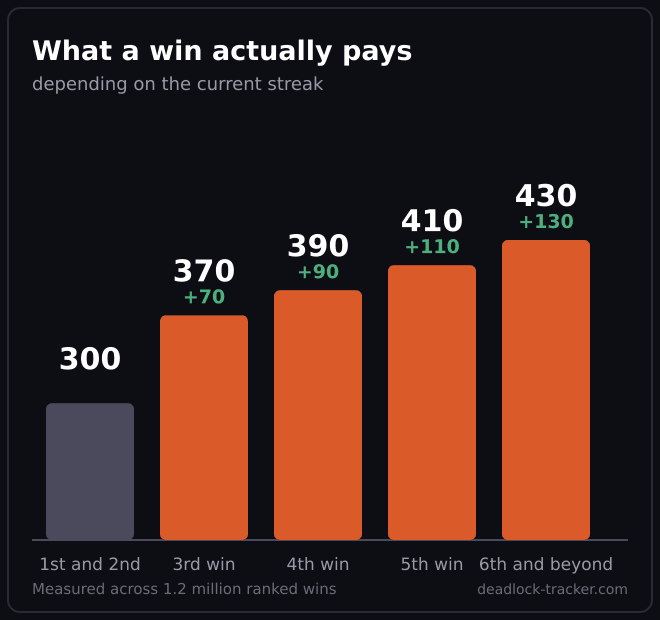
In practice: the first two wins pay 300, the third 370, the fourth 390, the fifth 410, and from the sixth onwards 430 — with no time limit, but no further increase either. Roughly 28% of wins carry one of these bonuses.
The second exception is demotion protection, and it weighs more than people assume: 17% of losses are cushioned. Instead of −300, they cost −136 on average, sometimes as little as −25. It is the safety net that stops one bad evening from dropping you a rank.
Only one situation gets no mercy: abandoning. Of 8,370 quit matches, 8,060 were billed the full −300, protection or not.
The system gives more than it takes
Put both mechanisms together and the result is surprising. A win pays 324.5 points on average, a loss costs 271.5.
That is a 53-point gap, and it always leans the same way. A player who wins exactly as often as they lose is not standing still: they bank roughly 26 points per match, the equivalent of a free net win every eleven games.
What does that amount to? We checked the progression of three accounts at very different ranks: a sub-rank costs about 1,150 points, roughly four net wins. Which means a player at a 50% win rate still climbs a step every forty-five games or so.
Deadlock's ladder is therefore not a zero-sum game. One open question remains, and we will keep watching it: either ranks slowly inflate, or Valve raises the thresholds behind the scenes.
Where we got it wrong
On August 12, we reported that Valve was *preparing* tiered streak bonuses, based on three labels added to the interface and on the absence of values in the game files. We wrote that the live system was flat, capped at +90 points.
The counters say otherwise: the tiers have been live since August 3, with four distinct values. What Valve was preparing was the display — not the mechanism, which was already running, invisibly.
The lesson is worth keeping: client files do not always describe what the server applies. The August 12 story has been corrected accordingly.
Methodology. Data pulled on August 18, 2026 from the public SQL endpoint of deadlock-api.com, table `player_match_history`, column `ranked_delta`. Window: August 3 to 17, 2026, ranked mode only, non-zero deltas — 2,178,149 matches across 174,132 accounts. The comparison with the old system covers July 18 to August 1. Streak tiers were reconstructed by tying each win to the same account's five previous ranked matches, on a one-in-23 account sample. The overall sample runs at 56.7% wins, as the API mostly tracks active players: the net gain per match was therefore recomputed for a 50% win rate, which brings it down from 66 to 26 points. The cost of a sub-rank is estimated from three accounts only (tiers 5, 6 and 10) and remains an order of magnitude.