The penalty queue moves closer: what Valve shipped in silence last night
The silent August 20 patch prepares the tagging of low priority matches. We measured the problem it targets: one ranked game in 22 loses a player along the way, one in twelve in unranked.
At 20:05 UTC last night, Deadlock got an update. No patch notes, no announcement: build 6683 landed the way three quarters of the game's updates do — quietly. It comes to eight files, and one of them is worth a closer look.
What was added
Two network definition files changed. In one, a line appears: `low_pri_pool`, a plain boolean, added to a match record. In the other, that same field is grafted onto the match history — the one players check afterwards.
And the game's text file gets exactly one new entry: "Low Priority Match".
In other words: the game is getting ready to tag some of your matches as played in the penalty queue, and to show you.
What that queue has in store
The full system is spelled out in the game files, and it is harsh. The text written for players states that those who "intentionally grief or abandon matches will be put into a separate Low Priority Matchmaking queue", where they will only be matched with other offenders.
Three details matter more than the principle:
You have to win your way out, not merely play: the counter shown to players talks about wins remaining, not games. A sanctioned player on a losing run stays put.
Ranked is closed off, along with Street Brawl and Hero Labs. The penalty does not just isolate you: it locks you out of competitive play.
The whole party pays. If a single member is in low priority, the entire group is blocked. The prepared message is blunt: drop the penalised player, or wait.
Abandons are not the only trigger either — the files also mention "inappropriate behavior reported by other players".
How long this has been coming
This is where it gets interesting. The queue is not yesterday's idea: the earliest texts describing it have existed since at least November 2024, the limit of the public history. It has been sitting dormant in the files since the game's early days.
What changed recently is the pace. A complete interface — menu, remaining-games counter, blocking messages — appeared on July 30, 2026, the very day ranked mode launched. And last night, the match tagging.
Three pieces, laid down in order. That does not say when the machine gets switched on, but it does say someone is working on it.
The problem, in numbers
That leaves the question of whether the disease justifies the cure. We counted, across 857,291 matches played between August 3 and 19.
In ranked, 4.45% of matches lose at least one player along the way: one in 22. In unranked, it is 8.62%, one game in twelve.
The gap between the two modes is the most encouraging result of the lot. Ranked punishes abandoning with a full 300 rank points, without the protection that cushions ordinary losses — we measured that last week. And its abandon rate is half as high. The penalty works.
People do not quit in anger
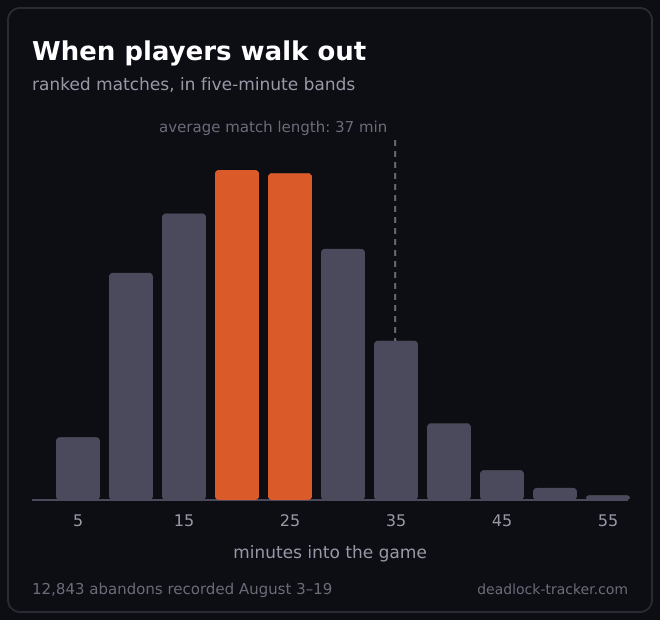
The timing contradicts the image of a player slamming the door at the first setback. No abandons before the five-minute mark — the game blocks it while the match is still deemed competitive. Then the curve climbs slowly, peaks between 20 and 30 minutes, and falls away.
The median lands at 24.7 minutes, in matches that run 37 minutes on average. Nobody leaves in a fit of rage: they leave two thirds of the way through, once the game looks decided.
That nuance matters going forward. A penalty queue deters the repeat offender; it does nothing about mid-match resignation, which is a comeback-balance problem instead.
A tiny minority
One last figure, and it tempers everything else. Of the 268,957 ranked players observed, 95.2% never abandoned a single match in seventeen days. 11,905 did it once. And only 1,046 players did it again — including two accounts with seven abandons.
So the penalty queue would target a few thousand players out of a quarter of a million. That is few, and that is exactly the argument: isolating that minority costs everyone almost nothing, and improves one match in twenty-two.
What we cannot claim
A system being described in the files does not prove it is running. We learned that three days ago: the win streak bonus was configured at one value in the client files while the server had been paying out another for two weeks.
Files tell you what Valve is preparing, never what Valve applies. What we can state stops here: the field was added last night, the label exists, and the match history is ready to display it. If the queue switches on, we will see it in the data — and we will say so.
In passing. The same build quietly tweaks an ability: the ground flame trail of Paige's Bookwyrm sees its aura spacing go from 1 to 2 metres, now scaling with tech range. One more discreet adjustment, in a patch that officially does not exist.
Methodology. Build 6683 contents examined on August 21, 2026 in the SteamTracking/GameTracking-Deadlock tracking repository (commit of August 20, 20:05 UTC), files `citadel_gcmessages_client.proto`, `citadel_main_english.txt` and `abilities.vdata`. The absence of patch notes was verified against Valve's Steam announcements feed, whose latest entry dates from August 12. Text dating relies on the commit history of the localization file, which goes back to November 26, 2024. Abandon measurements come from the public SQL endpoint of deadlock-api.com, table `match_player` (complete matches, averaging 12.00 players per ranked game), August 3 to 19, 2026: 285,518 ranked and 571,773 unranked matches. The repeat-offender count uses `player_match_history` and the `Penalized` status; as that status has only been recorded since late July, no comparison with earlier months is possible.