Patch 44 fact-checked: only one hero actually moved
Thirteen heroes hit, 86,000 matches played since. Compared against the heroes Valve left alone, only one shift beats chance — and it is the one nobody expected anymore.
Two days after a patch, everyone has an opinion. We preferred to count.
The August 12 patch touched thirteen heroes. Since then, 86,000 matches have been played. That is enough to measure what actually moved — provided you know what you are looking at.
First, the ground rules
Win rates drift on their own. Players change, compositions vary, randomness does the rest. Before declaring success or failure, you need to know how much a win rate moves when nothing is changed at all.
So we measured the 25 heroes the patch did not touch. Verdict: they varied by 1 point at most, in either direction.
That is our threshold. Below one point, a gap means nothing.
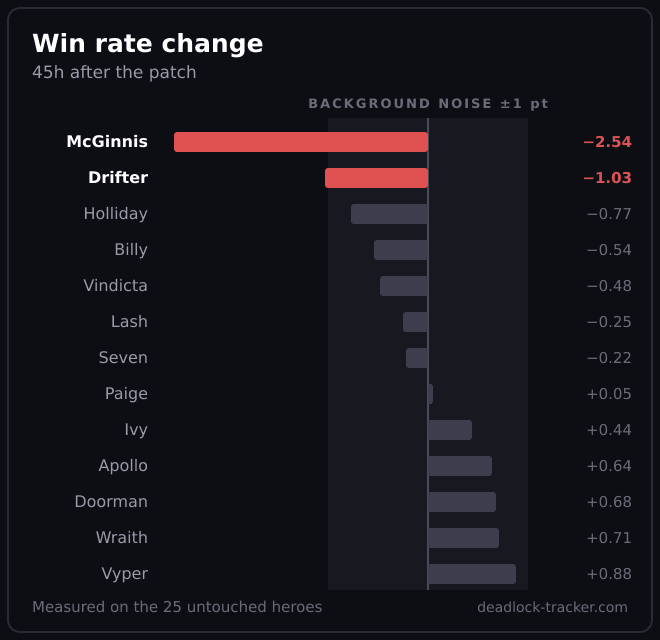
Only one hero stands out
McGinnis drops 2.54 points, from 53.94% to 51.40%. Two and a half times the background noise. It is the patch's only clear-cut result.
And it is a small story in itself. Five days ago we reported that McGinnis was the most-changed hero of the beta: 109 changes, 43 of them nerfs, without ever leaving the top of the table. Valve could not slow him down.
This time it worked. The difference may lie in the target: instead of shaving his damage, the patch went after his turrets — no more shooting players on ziplines, and the loss of their first six seconds of resistance — and after his survivability, with spirit resistance nearly halved.
Drifter follows at −1.03 points, just above the threshold. Three nerfs for an effect that still needs confirming.
The other eleven did not move
This is the most instructive result, and the least spectacular: eleven heroes out of thirteen stay within the noise.
Some cases are amusing. Wraith received two nerfs and his win rate went up by 0.71 points. The Doorman, nerfed twice against one buff, gains 0.68. Vyper, buffed twice, gains 0.88 — the largest move of the patch, and still inside the margin of error.
None of those three numbers proves anything. Which is exactly why it is worth saying.
What cannot be claimed yet
Forty-five hours is short. Two caveats apply.
The first is the novelty bias: right after a patch, players pull out the changed heroes to try them, often without mastering them, which drags win rates down. That bias is real, but it does not dominate here — otherwise all thirteen heroes would be falling, whereas we count six down against five up.
The second is adaptation time. A nerfed hero can climb back once players find the workaround, and a buffed one can take off later, when the community works out what it gained. The final verdict plays out over two weeks, not two days.
What to take away
A patch touching thirteen heroes does not move thirteen heroes. On this one, a single shift is established, a second is likely, and the other eleven are for now intentions rather than results.
This is not a criticism of Valve: tuning at the margins is part of the job, and a change with no measurable effect is sometimes a successful one — the kind that fixes without breaking. But it is worth stating, when most patch reviews announce thirteen heroes upended by the next morning.
Methodology. Win rates collected on August 14, 2026 through the public deadlock-api.com API, all modes combined. "Before" window: July 30 to the patch's release on August 12 at 22:57 UTC. "After" window: from that release to August 14, roughly 86,000 matches. Background noise is the variation observed across the 25 heroes untouched by the patch with more than 5,000 recorded appearances over the period. Buff/nerf classifications are our own, reviewed by hand after the patch went live.