Valve ships on Thursday — and spends the night fixing it
A parody site claims Deadlock patches land on Thursday. We checked it against 42 patches and 810 shipped builds: it holds, the hour is even more regular than the day, and activity multiplies by seven in the twelve hours after an announcement.
There is a site that claims to guess the date of the next Deadlock patch from the number of birds in the park across from Valve's headquarters, the crowding of Bellevue's pizza places, and the position of Gabe Newell's yacht. It is called YoshiTracker, and it is exactly as funny as it sounds.
Except that, in among the planetary retrogrades — weighted at 0.3, "due to minimal credibility", as the authors put it — it makes one perfectly serious claim: Valve ships on Thursday. We checked it against our own data. It is true, and it is more interesting than it looks.
Thursday, no contest
Across the 42 announced patches we have recorded since October 2024, fifteen landed on a Thursday. Friday follows with nine. Then Monday at six, Tuesday at five, Wednesday at four, Sunday at two — and Saturday at exactly one.
One methodological detail changes everything: these days are counted in Bellevue time, where the team works. It is Valve's calendar that matters, not ours. And moving to their timezone strengthens the result rather than blurring it: three patches the world received on a Friday were still Thursday evening over there. In UTC, Thursday only reaches twelve; in Bellevue, it climbs to fifteen.
The pattern is sharpening. Over the last twelve months, Thursday rises to 40% of announcements.
A bias worth removing
An attentive reader will object that Valve introduced its new heroes through weekly posts, four of which fall on a Thursday in January and February 2026. Those thirteen introduction posts carry no balance changes at all: they inflate the total without saying anything about patch rhythm.
So we removed them. Keeping only the 29 patches that carry real changes, Thursday still leads: eleven against six Fridays. That is 38% instead of 36. The bias is real; it overturns nothing.
And at 2 pm
The real surprise is not the day, it is the hour. 86% of patches go out between noon and 6 pm, Bellevue time. The peak is sharp: thirteen of the 42 patches shipped in the 2 pm hour, nearly one in three.
That means 10 pm UTC — late evening across Europe, mid-afternoon on the US East Coast. Not the morning, not during the working day: right when you assume nothing more is coming.
What the build calendar says instead
The production side deserved the same check. Every time a build actually reaches players' machines, a version file changes, and a public repository keeps the record. We counted 810 of them since August 2024 — a little over one a day, when only 42 got an announcement. Four builds out of five ship on a day Valve says nothing — even more than the two in three we had measured over the summer.
And those 810 builds do not follow the announcement calendar. Friday concentrates them, with a quarter of the total, ahead of Thursday. Weekends are thin, Sunday nearly empty, but no day is deserted.
In other words: Valve works every day, and communicates on one particular day. Those are not the same clock.
What happens right after an announcement
The most telling result lies elsewhere. We counted the builds shipped around each announcement, in twelve-hour bands.
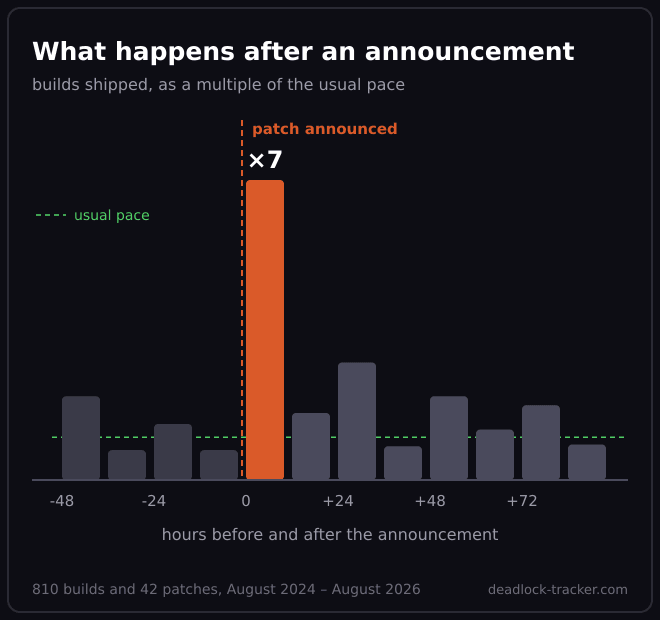
In the twelve hours after an announcement, the pace is multiplied by seven. A little over one build a day normally, seven that day. Then activity drops — before a second bump, nearly three times normal, between 24 and 36 hours later.
That curve describes a working day nobody documents: the patch goes out, the team stays, and fixes. The next day, it comes back to finish. It is also the best reason not to judge a patch in the hour after it drops — part of what you play on Thursday night will already have changed by Friday morning.
So when is the next one?
The last patch landed on August 22. It was a Saturday: the only Saturday in our entire record, a day Valve had shipped on exactly once in two years. Regularity has its exceptions, and it just produced one.
What the numbers allow us to say fits in one sentence: if a patch arrives this week, Thursday evening is the likeliest moment, and 2 pm Bellevue the likeliest hour. That is not a prediction, it is a frequency — and across 42 patches, it held fifteen times.
For the version with the birds and the yacht, go and see YoshiTracker. Their method is funnier than ours, and on Thursday, they were right.
What we cannot claim. A build's timestamp is that of its record in the public repository, a few minutes after it went live; the gap is negligible at the scale of a day, not at the scale of an hour. The 810 builds include purely technical ones, which we do not attempt to separate here. And a past frequency predicts nothing: these figures describe a team habit, not a commitment from Valve, which has never announced a shipping day.
Methodology. The 42 announced patches come from our own database, fed by Deadlock's Steam news feed, from October 24, 2024 to August 22, 2026. The 810 shipped builds are the commits in the GameTracking-Deadlock repository touching `game/citadel/steam.inf`, from August 10, 2024 to August 22, 2026 — that file only changes when a build is actually distributed. Days and hours converted to Bellevue time (America/Los_Angeles), daylight saving included. The reference pace is the average over the whole period, 1.09 builds per day. The subject was suggested to us by yoshitracker.com, from which we took no figures: every number here is recomputed from our own records.